
By Nancy Miller Chenier
Before 1960, the tallest structures visible in the Lowertown East skyline were the steeples of Ste. Anne church and the Good Shepherd convent. The following decades saw major changes in this small-scale low-rise neighbourhood east of King Edward Avenue. Demolition and redevelopment were central to the planned urban renewal activities in the area. Single family homes as well as commercial sites were viewed as prime locations for replacement buildings and the demand for apartment and office towers was strong.
In September 1963, C. A. Fitzsimmons and Co. Ltd. Realtor-Insurance advertised the six-storey Lorraine Apartments at 345 Clarence Street, now Barber Street. It had 110 units at moderate rents in a new building featuring an elevator. The same year, the Ottawa Citizen outlined plans for Macdonald Manor on the site of the old Ottawa Transportation Commission streetcar barns between Cobourg and Augusta streets. Supported by Mayor Charlotte Whitton and businessman Reuben Palef, the building for elderly people on low incomes would be six storeys along Cobourg with seven sloping down to Augusta.
By 1964, two much taller structures joined the scene. The 12-storey Seigniory apartments advertised luxury units overlooking the Rideau River on Wurtemburg Street. With a different purpose in mind, the 11-storey E. A. Bourque Memorial Building offered spaces for federal government employees in offices at the corner of Rideau Street and King Edward.
The Bourque Building, now adapted to be Theo student housing, was the project of Laurentian Realties. The company owners and operators, Édouard, Pierre and Bernard Bourque, intended it as a tribute to their father, Edouard Adeceus Bourque (1886-1962), former Lowertown resident and Ottawa mayor in 1949 and 1950. In 1964, Ottawa media reported that it was to be the largest building in Ottawa, with the maximum allowable building code height, and a cost of $4,500,000.
The firm hired George E. Bemi to design the Bourque commercial building. As Bemi’s first large office structure, it was seen as the beginning of a trend away from smooth modernism to a more textured building. Described as having a two-storey commercial podium topped by a nine-storey tower, exterior finishes included a mixture of precast concrete ribs and concrete panels with glass, all elements indicating a clear vertical emphasis. The interior was to be fully air-conditioned and serviced by four high-speed elevators.
The Seigniory at 111 Wurtemburg Street was the first venture of Cadillac Development Corporation in Ottawa. In January 1964, the Ottawa Citizen reported that Cadillac Construction Associates were nearing completion on their 12-storey apartment building costing $2,500,000.
Early advertisements from the company used the slogan: “THE PEOPLE WHO PUT THE ART IN APARTMENT LIVING.” Rents were proclaimed to be remarkably modest – $110 for a bachelor, from $120 for one bedroom, $148 for two bedrooms and $245 for three bedrooms.
John H. Daniel had joined the Cadillac Development Corporation as an architect in 1961 and within a few years his “Seigniory” design was advertised as “the most advanced, most distinctive apartment home ever built in Ottawa.” This white glazed luxury apartment building with balconies oriented to the Rideau River on one side and Macdonald Park on other had a uniformed doorman, sauna steam room, heated underground parking, roof deck solarium and other amenities. Descriptions pointed to the exterior with the impressive portico and gracious fountain while the interior featured a rotunda lobby with antique mirrors and crystal chandeliers identified as French Provincial décor.
The modernist styles of all the buildings represented a significant break from earlier Lowertown buildings. All were the first of their size and height and style in the area. These structures marked a change in the character and appearance of the community and the beginning of a trend that continues to this day.
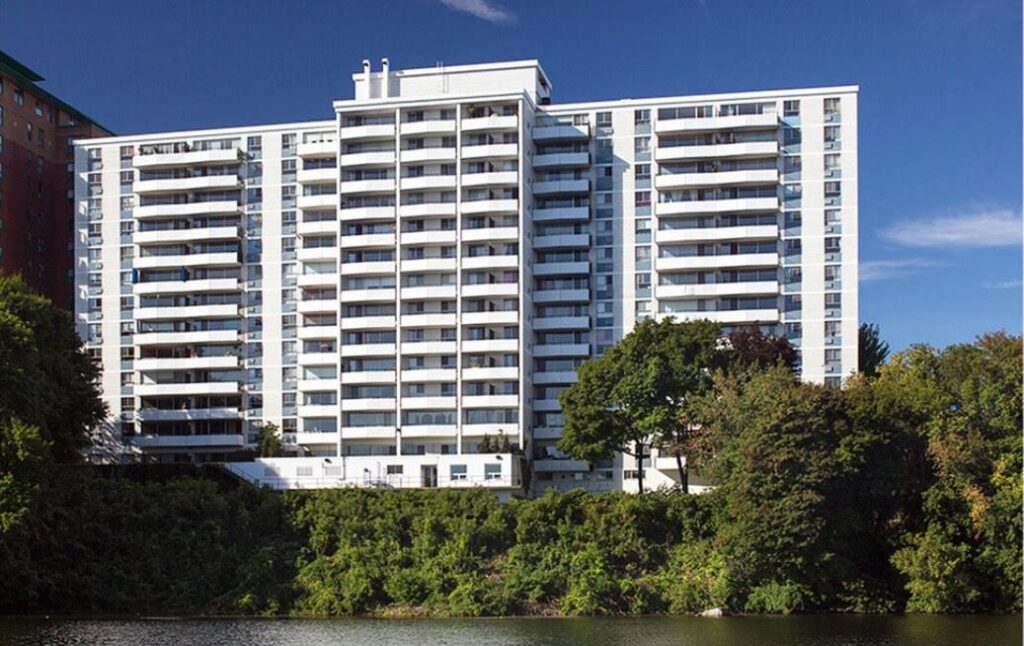
The Seigniory at 111 Wurtemburg Street (Photo: Apartments.com)
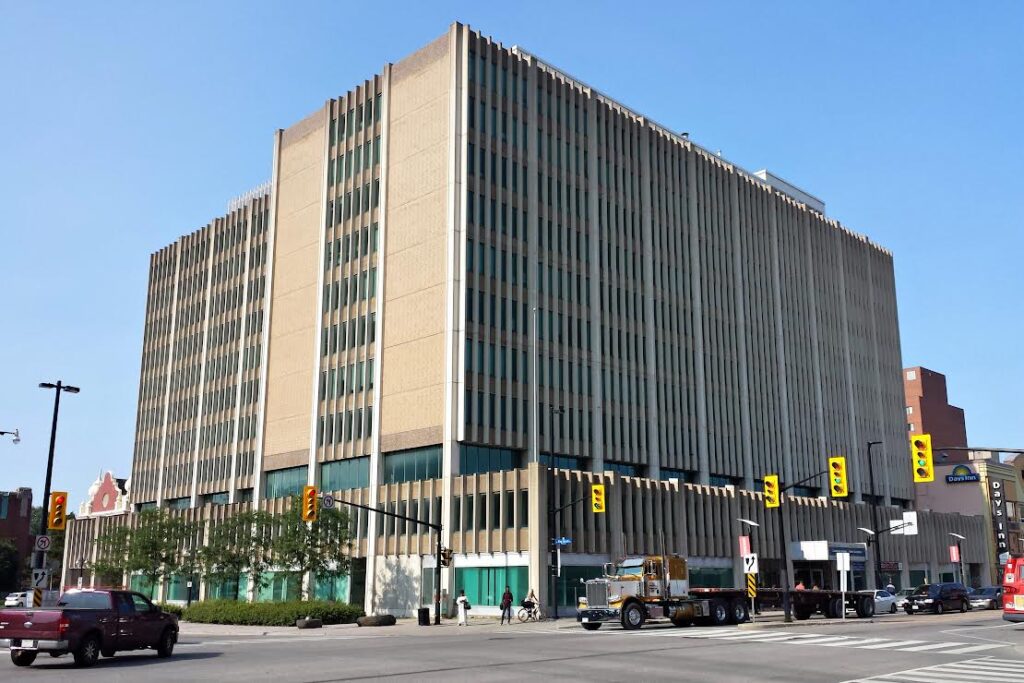
The Bourque Building (Photo: Wikimedia)
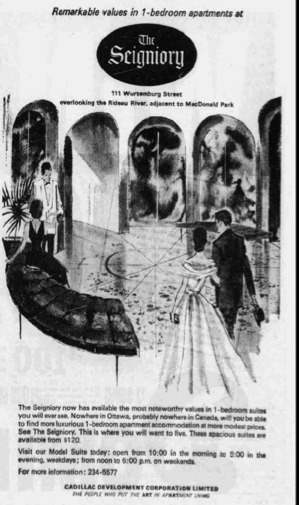
The Seigniory advertisement published in the Ottawa Citizen, 17 October 1964.