
By Nancy Miller Chenier
What is next for this historic building on Guigues Avenue? Over its nine decades in Lowertown, the Routhier building has served as a Catholic school for girls; an event venue for family celebrations and political meetings; a municipal community centre with a full-size gymnasium, a sprung-floor dance studio and rooms for community association meetings; and a storage location for city artworks and artifacts. Since early 2020, it has been a COVID isolation centre for single homeless individuals.
Routhier opened in 1932 as a new Notre-Dame parish school for girls. It was designed by architect Lucien Leblanc and built by Edouard Monette. In 1933, more than a thousand citizens were in attendance when the building was blessed with the name of Joseph Onesime Routhier (1836-1927), a long-serving vicar general and administrator of the diocese. According to the Ottawa Citizen, the school was modern and up to date; it cost $110,000 and had 16 classrooms, offices, and an auditorium.
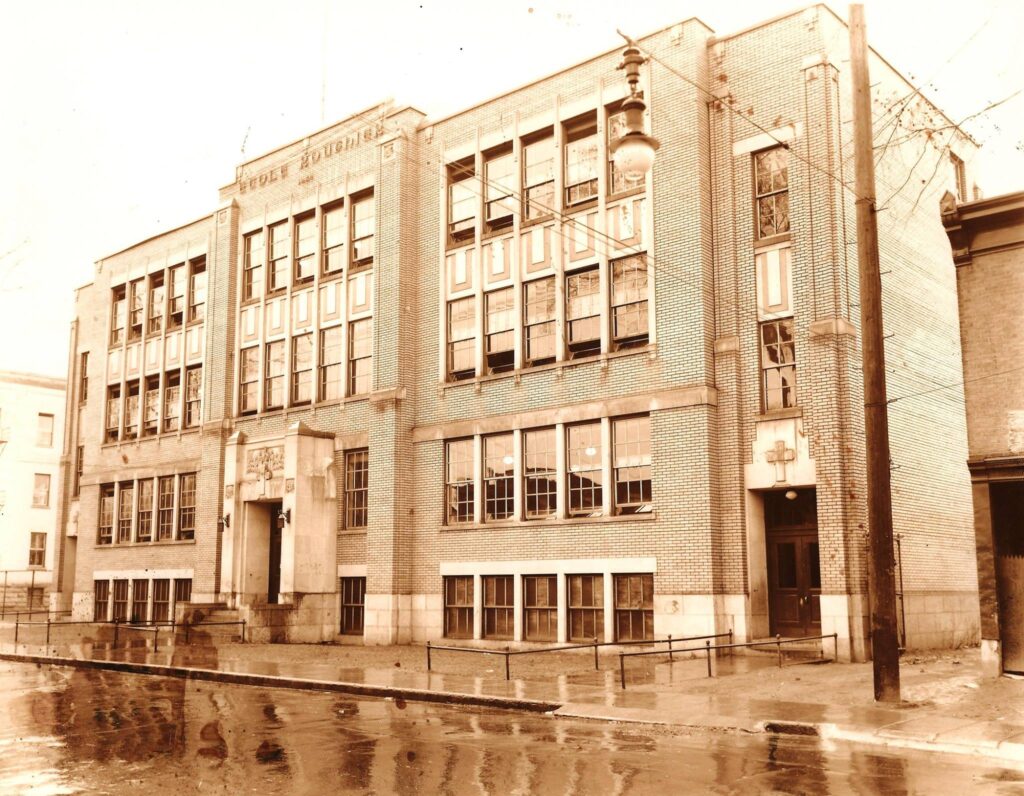
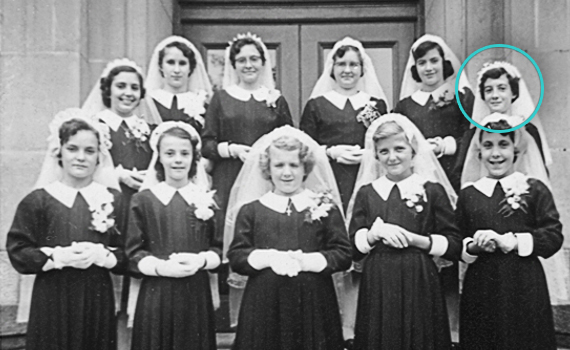
The images of the cross, a nun, and girls with books above the Guigues Street entrance proclaim its Catholic education origins, and in the following decades girls from the school won prizes for academic achievement, with a select few awarded scholarships for coveted places at Rideau Convent. In this bilingual school, girls like Louise Digeur of Redpath Street could be the Grand Champion in an English spelling bee. Lori Gregoire Sanders remembered that like other Lowertown girls, she spoke French as her first language, but the English lessons at the school served her well when she got her first job. Suzanne Pinel, well known by her musical character’s name, Marie-Soleil, grew up on Bruyère Street and her educational experience took her to teaching university courses and serving as a Canadian citizenship judge.
The auditorium in the building was a valued inclusion, and along with basement space the school served for multiple community activities. Residents celebrated wedding anniversaries. Provincial politicians held their election rallies. The St Joseph Orphanage held its Christmas parties. The Federated Association of Letter Carriers and Canadian Postal Employees of Ottawa held a mass meeting with 200 attendees calling for a salary increase. During the Second World War, the Eastern District of the Air Raid Precautions (ARP) had its headquarters in the school. The school building was also the distribution site for the ration books.
A decade later, the City acquired the school building and tendered for its renovation. It also held a community meeting to discuss improvements to the site. As a neighbourhood community centre, the building served a diverse range of functions. It hosted meetings of groups like the King Edward Task Force, Lowertown Community Association, Black History Ottawa and Historical Society of Ottawa. It offered rooms for garage sales, square dances, book launches, kitchen canning demonstrations, sewing classes, specialized badminton camps, and a dance school. It provided space for the City’s Heritage Programme Unit and storage for the Billings Estate artifacts and the municipal art collection.
COVID-19 meant that the services provided to the wider community were halted. In March 2020 as the pandemic spread and fears for the homeless population increased, the Routhier Community Centre opened as a temporary isolation centre. It took less than a week to create a 40-bed facility for people diagnosed with COVID or exposed to confirmed cases. The Mission provided the food while the Shepherds handled the laundry. Inner City Health organized nursing care and sought federal approval to prescribe drugs needed by opioid-addicted patients.
The temporary centre continues as COVID-19 is still spreading. Single homeless individuals still need to self-isolate. The city has committed to cleaning and maintaining the Centre before it is returned for community use. So perhaps by fall 2022, Lowertown residents and others can again access this community building and enjoy a range of activities.