
By Anwer and Areeba Khan
Communities from Cumberland to Lowertown to Goulbourn are upset, and have let the City know. Friday, 12th March was the formal deadline for submission of comments for the draft Official Plan (OP) and the City was inundated with comments, feedback, suggestions, and complaints.
The City acknowledged that it has received an “unprecedented level of public engagement on the draft OP, “far surpassing anything we had projected and what occurred during the last OP update.” While welcoming some positive developments, hundreds of residents and community associations have written in to recommend improvements and to castigate the City for a rushed and flawed engagement process and an overly complex and incomplete OP. This plan was drafted and rushed through during a once-in-a-century pandemic that has revealed new priorities and vulnerabilities for residents, businesses, community associations and the City itself.
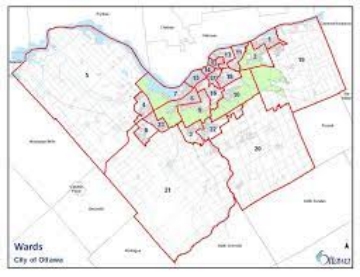
In March 2019 the City launched a multi-year process to replace the 2013 OP, with the release of discussion papers on key issues facing the City. This was followed by preliminary policy directions in August 2019, with Council voting to establish key directions of the draft OP, which was released in November 2020. From the beginning, the OP was a hasty process, with a politically determined deadline that did not change despite the challenges encountered during the COVID-19 pandemic.
Ottawans and local community associations across Ottawa were united in complaining about the sheer complexity of the OP. It has 264 pages, with multiple annexes and schedules and citations and references. There is confusing new and generic terminology to keep track of, such as transect, regeneration and overlay. There are 21 one-pagers available with feedback forms where feedback was measured by degree of agreement with various, almost seemingly randomly selected, statements or ideas rather than with actual policies. And until significant outcry and repeated requests, the OP was only available online.
All this occurred when residents, especially those who are marginalized and vulnerable, found themselves uniquely discouraged from public participation. Those without internet at home could no longer access libraries. Parents juggled their jobs with children’s virtual schooling from home. Childcare became impossible. So many suffered from anxiety and mental-health challenges in the wake of sustained economic pressures and continuing uncertainty and loneliness.
replacing houses with large multi-unit buildings.
Residents and community associations continue to call for a delay to the OP process, citing how other Ontario municipalities (e.g. Halton Hills) have agreed to delay their OP report decisions until in-person consultations can be conducted safely. This request has been denied by the Mayor and Council.
To its slight credit, faced with the sheer volume of concerns, the City has modified its approach, setting up further opportunities for Ottawans to further engage with the OP, such as a city-wide question-and-answer session, and an update on the 15-minute neighbourhood project. Both will take place in March. Furthermore, the City has indicated that there will be an As We Heard report in April 2021.
This will present another opportunity for residents to verify if the City truly did hear all the concerns, questions, and comments, and for residents to see how proposed policies have changed in light of public engagement. There will be opportunities for residents to give further feedback and provide commentary before the submission to the Planning Committee in the fall, when residents will be able to present their case, either in writing, or in a five-minute presentation in person.

Beyond the overly complex presentation of the OP and the lackadaisical plans for public engagement accompanying it, residents and community associations also identified serious concerns with the contents. Ironically, the OP lacks a plan to monitor the City and hold it accountable or to measure its performance on the multiple laudable goals the City set itself. There is not enough attention paid to equity.
While the Plan acknowledges the importance of a by-law mandating a certain proportion of affordable housing in multi-unit developments, it fails to set out any clear objectives and principles. There is considerable community concern that the Heritage Management Plan and some Secondary Plans are missing. The draft OP sets a welcome goal of 40% tree canopy but considers it city wide rather than for each neighbourhood. Moreover, the draft OP does not go far enough in integrating Climate Change and Energy Evolution strategic recommendations.
The Lowertown Community Association also identified specific concerns, including concerns regarding the ByWard Market Special District. In the draft OP, it is focused entirely on cultural programming, patios, nightlife and commercial activities. There are no policies encouraging the farmer’s market or small retailers and no acknowledgement that hundreds of people live in the Market and thousands more surround it. This vision does not consider the many problems facing the ByWard Market and it is a significant departure from the current secondary plan without consultation.
Also, the Plan further disappoints in that, after almost 60 years following the construction of a major inter-provincial truck route through Lowertown and downtown Ottawa, the draft OP only commits to “collaborate” with other agencies to identify future crossing(s) to relocate the interprovincial truck route away from downtown.
This is not to say that the OP is irredeemable. Far from it. There is excellent material on the environment and resilience, noteworthy recognition of Ottawa parks as components of the city’s greenspace, and laudable goals on mixed-use and walkable neighbourhoods. In particular, the ambitious 60% intensification target is worthy of celebration. It will be important, however, to ensure that the infill is respectful of each neighbourhood and gradual in height, rather than stark.
Overall, the draft OP contains a series of often worthy goals that lack clarity on prioritization between competing or overlapping goals. It seems to provide justification for almost any decision city planners or developers may wish to make in the future. And the plan does not go far in healing the wounds of amalgamation that continue to scar the ability of communities to chart their own course within Ottawa. Ideally, we would like the City to take more responsibility for the future development of Ottawa, rather than let the private sector direct development, and for the OP to reflect that.
It is up to all Lowertown residents and the wider Ottawa community to hold our planners and councillors to account, and to make sure that our voices are heard in the upcoming engagement opportunities as the draft OP is revised and submitted to the Planning Committee in the fall. The draft OP will be strengthened by incorporating insights and perspectives across Ottawa. With our input and insight, the draft OP can become an incredible success, or at least better, and Ottawa can achieve, or at least continue on, its vision of transforming into the most liveable mid-sized city in North