
By Curtis Wolfe
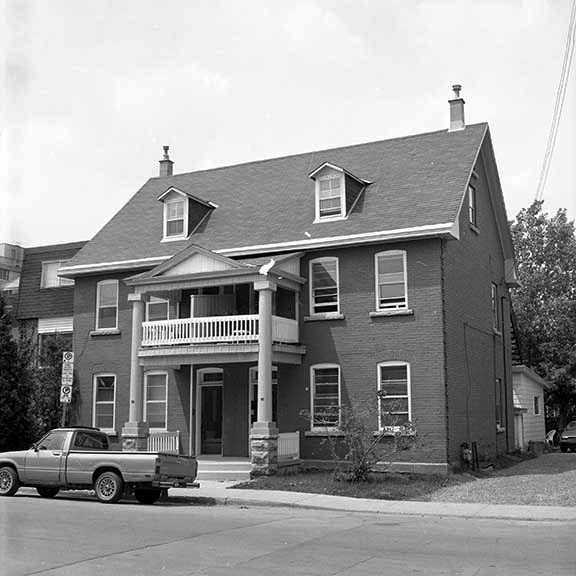
At times, 19th-century Lowertown is unfairly perceived as a rough-and-tumble neighbourhood inhabited by low-income labourers in poorly built homes. However, the story of 95-97 St. Andrew reveals a different perspective. This building was home to several members of the more affluent Olivier family, one of Bytown’s earliest francophone families.
The lot at 95-97 was originally owned by Prosper Olivier, recognized as one of the 12 early major landowners in Lowertown. He married Angelique Lionais in 1833 in the wooden chapel dedicated to Saint James that existed on the site of the current Notre-Dame Cathedral Basilica. He owned several lots, including many on the north side of St. Andrew, before he sold them all before 1849.
It seems that in the second half of the 19th century there were two Elie Oliviers who were closely related living in the Ottawa area. One of them, likely Prosper’s son, owned the property from at least 1871 and would have arranged the construction of 95-97 in 1875.
Elie’s trade as a millwright would have given him engineering and mechanical expertise, as millwrights were responsible for the construction and maintenance of equipment like driveshafts, gearing and mechanical belts necessary for the operation of mills.
The building at 95-97 St. Andrew has the original brick façade and two-storey monumental columns forming a porch. These design features were uncommon in Bytown during the period, suggesting the Oliviers had means to invest in architectural details.
Although the building has been described as having a Colonial Revival appearance, a style that only gained popularity in the early 1900s, the builders would have more likely been influenced by local vernacular Georgian or Palladian architecture trends that emphasized symmetry and classical motifs.
As such, the building may be considered noteworthy since monumental two-storey entry porches only became fashionable later in the 19th century. It is even possible that the original columns remain intact under the current metal covering and that interesting details are concealed.
In addition, these more costly architectural features are significant given that there was a global depression when the house was built in the 1870s. Because of the depression, it’s conceivable that the building became two addresses so the Oliviers could rent one half or use it to house family members. Initially, only 95 St. Andrew appears as an address in city directories, but starting in the 1870s, 97 St. Andrew was added.
Elie had two relatives, sons of the other Elie Olivier and likely either his cousins or nephews, with connections to the Olivier home. Elie’s godson J.L. (Joseph Lactance) Olivier, “a man held in high esteem by all,” resided in 95 and worked at the Post Office Department’s money order branch. In 1893 and 1894 he was elected as an Ottawa Ward Alderman. For a time he was also the secretary-treasurer of the Lake Temiscamingue Colonization Society.
J.L.’s brother Louis-Adolphe was living at 95 St. Andrew in 1881. He became a lawyer in 1878 and worked for George Taillon and Associates before becoming Ontario’s first French-Canadian judge.
At various times, rooms were rented out to tenants who were also from Ottawa’s more prosperous francophone community. For instance, in 1876 Cyrille Junet lived in the building and worked at the Department of the Militia. Pierre Ratté also lived in the building in 1879 and was a door keeper at the Senate.
Editor’s note: This property is currently for sale and is advertised as “ideal for demolition.”