
By Caroline Lavoie
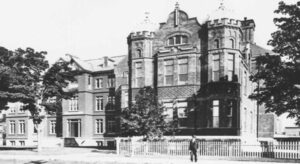
It is said that cats have nine lives. Wallis House, a Lowertown heritage landmark located at the corner of Rideau and Charlotte, has not had quite as many lives, but its 150 years of existence is replete with history.
Hospital
Wallis House was not always known by that name. Built in 1873 by Architect Robert Surtees, with an additional wing by Alexander Hutchison added in 1898, its first life started as the Carleton County General Protestant Hospital. With 75 beds, and male and female wards, it remained in operation until 1924, when several of Ottawa’s hospitals were merged to form the Civic Hospital on Carling Avenue. Paying patients were entitled to good food and even wine, but according to the hospital’s annual reports, there were more non-paying patients admitted. The top floor was used as storage for drugs and tools, as well as patients’ clothing for the duration of their stay. The morgue was located in the basement. It was a teaching hospital for the Lady Stanley Institute for Trained Nurses, then located next door, at the corner of Rideau and Wurtemburg.
Seminary
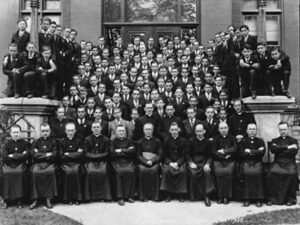
For its second life, the building changed its religious denomination! The old Protestant hospital was sold in 1924 to the Catholic Diocese to serve as a major and minor seminary. The major seminary trained future priests, while the minor one was a boys-only school. This second life is less well documented, aside from a postcard entitled “Séminaire d’Ottawa”, where the building is clearly recognizable. But during Doors Open Ottawa in 2019, a generous visitor kindly donated her late father’s photos and report card from his time as a student in the Seminary in the mid-1930s.
Barracks
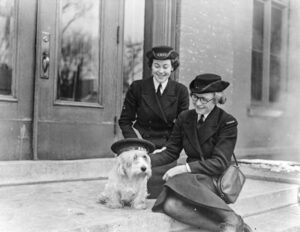
Wallis House started its third life after the failed Dieppe landing in August 1942. The strong emotional reaction to significant casualties among Canadian soldiers led the Armed Forces to set up women’s regiments of the Navy, Army and Air Force. In 1943, the building was renamed “Wallis House” in honour of Provo Wallis, a hero of the War of 1812. It became the barracks of the Women’s Royal Canadian Naval Service (WRCNS), who were called “Wrens” after their British counterparts in the Women’s Royal Navy Service.
After the Wrens were demobilized two years later, Wallis House became the barracks of the Ceremonial Guard for a couple of summers, then a Korean War recruitment centre in the early 1950s. It also served as an armoury, and a place for administrative services, transport logistics and communications.
Temporary shelter
This third life is well documented by the many photos and souvenirs later shared by the Wrens. The Emergency Federal Housing Corporation also briefly requisitioned Wallis House after WWII to serve as temporary shelter for 47 destitute families, thus giving the building a brief fourth life.
Neglect and abandoned
The fifth life of Wallis House was one of neglect and abandonment. Vacated by the Department of National Defense in 1990, the building was left unheated, and deteriorated greatly. No developer was willing to pay for the old derelict building, and a demolition permit was issued in the mid-1990s despite the designation of Wallis House as a heritage building.
Housing
Heritage Developer Sandy Smallwood gave Wallis House its sixth life. To help finance restoration, part of the lot was sold to Domicile Developments for row-house construction, and to the City of Ottawa for an apartment building next door. In 1996, Wallis House was registered as a condominium, and its 46 units sold within a day or two, starting from only $ 90,000!
It is a miracle that such a building still stands today, after narrowly escaping demolition at least once in its lifetime. Let’s hope that this ultimate life of the building will last another 150 years!