
By Nancy Miller Chenier
In Lowertown, individuals and families, entrepreneurs in diverse businesses and professionals in numerous fields continue to share their cultural traditions and enrich our neighbourhoods.
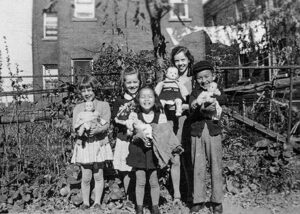
Many Lowertowners are familiar with the story of Adrienne Clarkson and the Poy family’s escape from wartime Hong Kong in 1942. Three-year-old Adrienne Poy and her parents and her older brother, Neville, had one suitcase each as they settled at 277 Sussex. In her memoir, Heart Matters, she remembers French-Canadian neighbours who spontaneously helped her family, as well as teachers at York Street Public School who recognized her abilities.
The stories of earlier Chinese residents in Lowertown are not so well documented and not always so positive. In April 1880, the Ottawa Citizen reported in rather derogatory language that a Chinese man walking on Sussex Drive was attacked by a boy with a brick. The next day, Wang Lee reported that two boys had assaulted him and broken the windows in his laundry. They were fined $2 each plus costs. The following month, the same paper reported that the two “Heathen Chinese” who had established a laundry on York Street were planning to leave town.
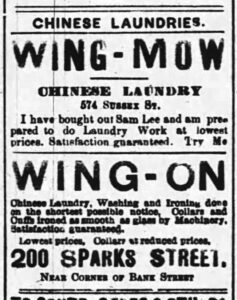
According to the “Old-Time Stuff” page in the Ottawa Citizen, it was 1885 before Chinese individuals arrived to settle for a longer term in the city. Ottawa directories around that time identify a couple of Chinese laundries in Lowertown: Jim Lee on Rideau Street in 1885; Sam Lee on Sussex in 1887; and Sam Wah on Rideau in 1888.
1885 was also the year when the Chinese Immigration Act sought to exclude Chinese individuals by imposing a head tax of $50 (eventually increased to $500) to reside in Canada. And by now, Chinese male labourers were no longer needed to build the Canadian Pacific Railway. Facing life in Canada with limited money and language skills, some men migrated east to Ottawa and established or worked in hand laundries. As they got more settled, some opened cafes or restaurants.
By the time of the 1891 census, five Chinese men were reported in Ottawa with three listed as operating laundries. Wing Mow was on Sussex, where he had purchased the laundry from Sam Lee. Although the work was hard — washing, boiling, pressing, ironing and waxing in hot, cramped conditions for long hours — the Sussex laundry operated for several decades.
In 1901, the city directory list of laundries indicated that Dalhousie Street had five establishments under the names of Hing Kee, Mark Sing, Mark Wah, Sang Long and Wing Hum. While there were other laundries in Lowertown, a newspaper search provides a small glimpse into the lives of these five men. In 1896, Hing Kee reported to the police that his business near the corner of Church Street (now Guigues Avenue) had been robbed. Despite the loss of money and the damage to his business, Kee continued to operate a laundry on Dalhousie Street for another decade. Within a few years, Mark Sing and Mark Wah went on to open restaurants along Bank and Metcalfe streets. In 1906, Sang Long and Wing Hum were still on Dalhousie when newspapers reported that, along with multiple Chinese laundries across the city, their businesses had been robbed.
Despite the difficulties, the Chinese community in Ottawa grew, and the city now proudly promotes its “Chinatown” with an entrance signaled by a traditional Chinese-style arched gateway.
Ottawa’s Chinese population in 1911 was recorded at close to 170. The majority of Chinese businesses were located in areas outside of Lowertown, with the greatest number of laundries along Bank Street. Of the eight restaurants, only one was on Rideau Street. Throughout the city, their owners often faced less than friendly conditions, including abusive language, frequent robberies, physical violence and major opposition from the competing non-Chinese laundries. At this time, the men still lived in an all-male environment, many with no ability to marry and some married but unable to pay the tax to bring their wives and families over from China. At this time, the only Chinese woman in Ottawa other than the wife of the Chinese consul-general was reported to be the wife of Hum Quon, a merchant on Albert Street.
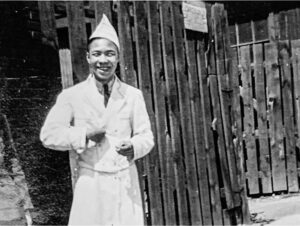
(Photo: Courtesy of the Hum family)
The 1921 census records a James Wong Hum, restauranteur, his wife Kung Shee and their three children at 66 Rideau Street, along with multiple lodgers. The three children, ranging from one to six years of age, were born in Ontario. In 1909, a personal advertisement in the Ottawa Citizen indicated that James Wong and Hum Kee were moving Ontario Lunch from 555 Sussex to 64 Rideau over the Kilt’s Bookstore. After Hum Kee’s death in 1934, the Rideau Street restaurant, now at 66 Rideau and called the Ontario Café, was taken over by his oldest son Thomas Hum. Thomas eventually helped finance several other restaurants, and also engaged in business with William Poy, Adrienne Clarkson’s father, in the Allied Trading firm, an investment and trading company.
Despite the difficulties, the Chinese community in Ottawa grew, and the city now proudly promotes its “Chinatown” with an entrance signalled by a traditional Chinese-style arched gateway. In Lowertown, individuals and families, entrepreneurs in diverse businesses and professionals in numerous fields continue to share their cultural traditions and enrich our neighbourhoods.