
By Alison Hobbs
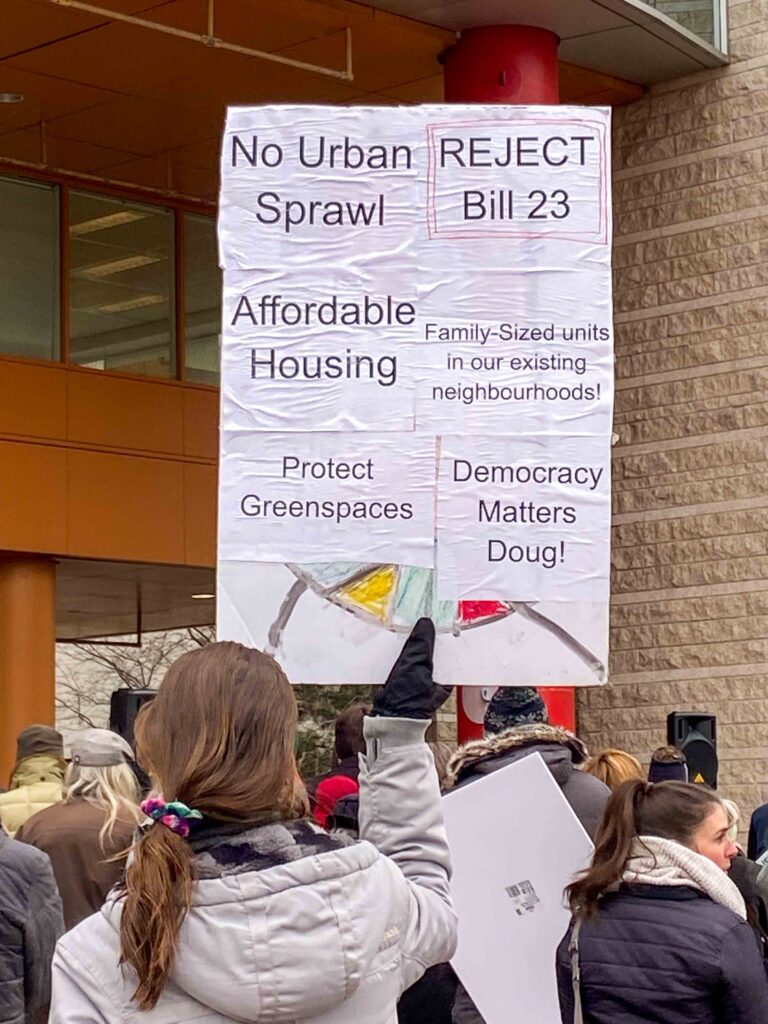
The present government of Ontario wants to eliminate red tape in home construction, and Bill 23, the More Homes Built Faster Act, eliminates or changes legislation included in several previous Acts. This is intended to alleviate our housing crisis by expediting the construction of 1,500,000 homes within ten years. However, many believe that the Act will not achieve its stated goal.
Dangers of urban sprawl
The provincial government admits that the measures in Bill 23 will deliver no more than 50,000 new homes within the boundaries of Ontario’s existing cities. The remaining 1,450,000 will be built on irreplaceable wildlife habitats and Class 1 farmland. The Canadian Association of Physicians for the Environment draws attention to the risk for food security and an escalation of “deadly air pollution,” adding that a significant increase in transportation infrastructure will intensify global warming. Conservation Ontario believes that Bill 23 “rolls back 70 years of successful, science-based watershed protection.” The new statutes “weaken the ability of Conservation Authorities to continue protecting people and property from natural hazards” such as flooding and water pollution. Insurance burdens will therefore be borne by taxpayers.
Increased densification with no protection for existing tenants
Although height limits will still apply, the new Act permits the addition of up to three new residential units, such as a basement suite or garden home, as of right — meaning that the owner does not have to pay development charges — on land zoned for a single home, without the need for a by-law amendment. This encourages densification within cities, no bad thing from an environmental point of view, but the revised legislation also overrides previous municipal policies which guaranteed that tenants of demolished rental buildings may live in the new buildings that take their place. “Affordable housing” is redefined at 80% of the market rate, much higher than before, and the required period to maintain that affordability is reduced from 99 to 25 years. We can now expect affordable units to be included in no more than 5% of any new residential development. Although the City of Ottawa’s Official Plan recommends up to 20%.
Threats to cultural heritage and green space
The new laws restrict the right of cities to control a building’s character, scale, appearance and exterior design. Because neighbourhood associations are now prohibited from making third-party appeals to the Ontario Land Tribunal on planning decisions, community leaders are voicing concern that our cultural heritage is under threat. Another contentious clause limits the inclusion of parks and other public spaces in new residential developments to about half of what was allowed previously.
Increased property taxes
Land speculators are now exempt from many charges typically levied by municipal governments, which, according to the legislation, “significantly impact the cost of development.” As a result, Ontario’s municipalities could face an income shortfall of approximately five billion dollars. Mayor Sutcliffe calls this impact “dramatic”, saying that Ottawa could lose $130 million in development fees over five years. Who will pay for the large-scale infrastructure in the new suburbs? Either these homes will be deprived of essential services, or everyone’s taxes will increase.
Ongoing pushback against Bill 23
Since November 2022, a coalition of social justice and environmental groups in Ottawa has been rallying members and supporters of the CommunityAssociations for Environmental Sustainability network to protest against the Bill. As the Manor Park Chronicle points out, “weakening the ability of councillors to influence policy will weaken cities.” At the first regular meeting of the new city council on November 30th, a motion proposed by Jeff Leiper (representing Kitchissippi Ward) and seconded by Laura Dudas (Orléans West-Innes Ward), asking that the Ontario government delay their implementation of Bill 23, was supported by a substantial majority of 20 councillors, including our own representative, Stéphanie Plante.