
By Liz MacKenzie
In August 2021, Libby Davis, who helped found the Downtown Eastside Residents Association, and was a Vancouver city councillor for 10 years and NDP MP from 1997-2015, made a very good point, which will guide my discussion of homelessness in Lowertown.
Homelessness is not about personal failure. It isn’t a social problem as so often portrayed by the media and those in power. Homelessness is a failure of public policy. Homelessness is a failure of the state, a failure of those in leadership who make conscious choices and decisions about who wins and who loses.
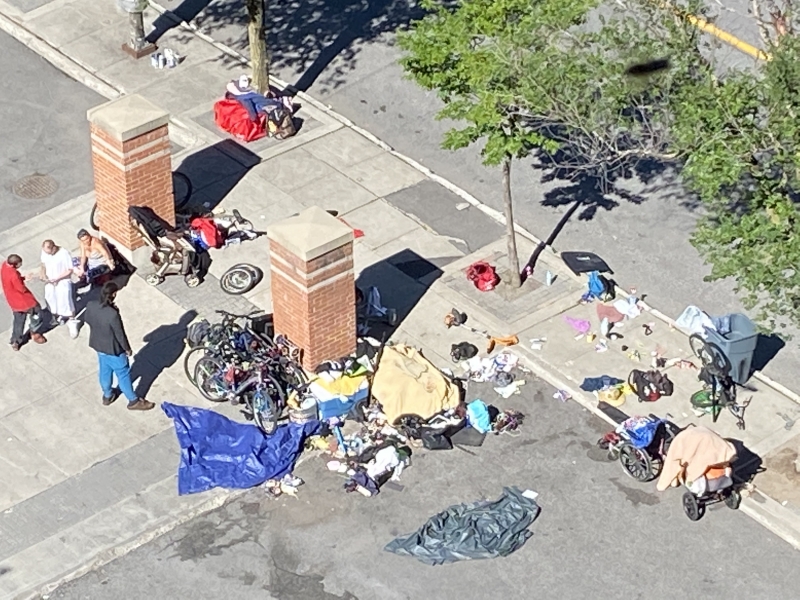
As the Lowertown neighbourhood encompasses two large shelters for the homeless, we residents of Lowertown live with everything that comes with such establishments: the homeless sleep in our local parks, beg in busy traffic, trespass on private property, and often steal. We see them sleeping on local sidewalks, using drugs throughout our neighbourhood, using our yards as toilets, and engaging in prostitution. We witness their mental health episodes and fear their rages. And we are saddened and moved when they die alone.
Why does this situation exist?
Surely it is not the fault of service agencies, who bear the burden of the City’s responsibilities.
Agencies do what they can, but as the problems escalate, it is clear that they are neither equipped nor competent to make any systemic changes. They offer a meal, a bed, a safe place to use drugs, and perhaps medical care or counselling from professionals who have few resources to offer.
Is it the fault of the people we see on the street? That doesn’t make sense. If they were given choices about their living conditions, would they choose such a difficult and dangerous life?
Should the police be doing more? Suppose all “offenders” were arrested – even if there was a jail, a hospital or hospice to accommodate them: then what?
And the City?
The homeless and the mentally ill are easily ignored, and the private and public agencies who can speak for them speak softly for fear of offending the hand that funds them, the City of Ottawa. The City has a responsibility to care for all its citizens, and the louder the voices, the more likely we are to see systemic changes. Bike lanes are an excellent example. Yet the City has continued to demonstrate a failure to adopt appropriate public policy and has failed to take responsibility for a situation that they have allowed to grow. The City has walked away from the caring for their homeless population, and in turn, their Lowertown residents.
The City continues to encourage the concentration of services in neighbourhoods already struggling with poverty, settlement issues, and violence. Residents in these neighbourhoods are collateral damage. While the City funds local social-service agencies to care for the homeless population, these agencies are underfunded and have little or no capacity to deal with the root cause of homelessness and mental illness. They simply help once people are already experiencing homelessness or mental health crises.
In addition, the cost of “externalities” is never considered. The concept of externalities is familiar to environmentalists and economists, and it refers to costs from the production of goods or provision of services that are borne by people other than the producers or consumers. The way the City serves and treats the homeless in Lowertown creates all sorts of externalities. Shelters are paid to provide a bed for the night. Supervised injection sites are supported to make sure drug users are safe when using drugs. Soup kitchens are paid to provide meals. No one would deny that these services are necessary, but there are externalities associated with the provision of these services and the more such services are concentrated in a specific area, the higher the cost of these externalities (i.e. petty crime and vandalism, prostitution, threats to personal safety, excess garbage and increased pressure on community services). Few are prepared to acknowledge these externalities, and no one will accept responsibility for addressing them. Instead, the costs are borne by the residents, community support groups and businesses of Lowertown.
The City of Ottawa hasn’t a clue and doesn’t care, as long as someone can be given praise and pennies to take the problem off their hands and keep it out of prosperous neighbourhoods. Despite their scorn for NIMBYism, the City, with unashamed hypocrisy, excels at Not In My (Affluent Voters’) Back yard.
Our neighbourhoods will not be safe, nor will there be real care and treatment for the most vulnerable citizens until the City of Ottawa accepts its responsibility to ensure that streets are safe and calm for all residents, agencies, and businesses.
There is a nice sentiment in the City’s Official Plan:
promoting people’s health, happiness and well-being, support liveable communities and healthy environments, Ottawa’s communities and people are healthy, safe and actively engaged in their well-being.
But without action, these words are meaningless.
The City must recognize that the care of the homeless and the mentally ill is a civic responsibility which cannot to be sluffed off to disparate agencies with inadequate resources and their own agendas, operating in oversaturated neighbourhoods.
Change will only come with leadership, compassion, and civic responsibility.
It is time the City stepped up the challenge and took responsibility.