By Sally Kearsley and Caroline Lavoie
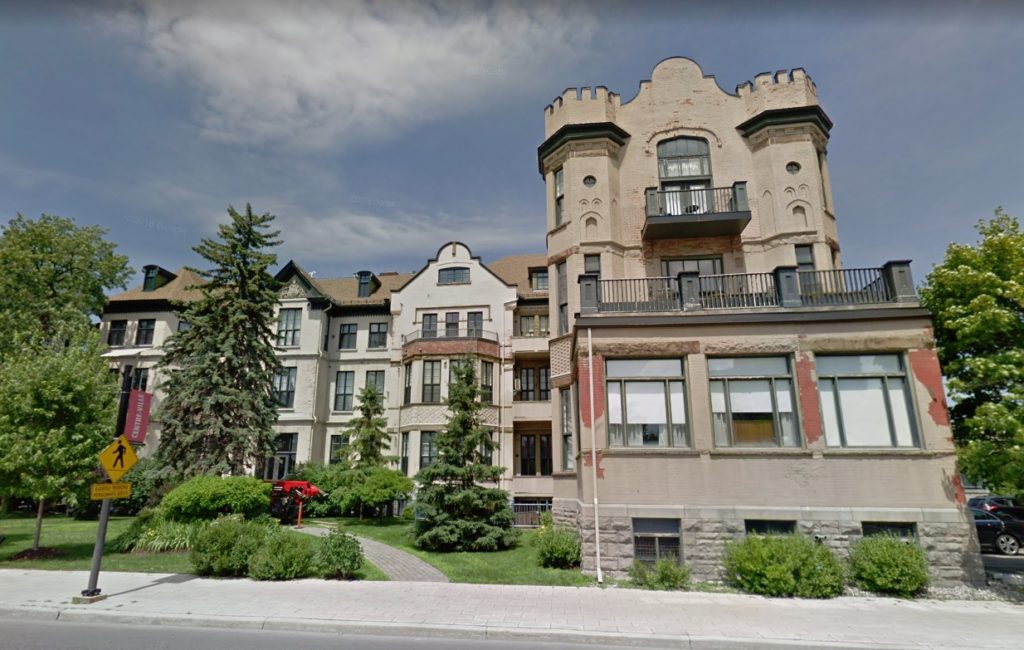
Did you know we owe the existence of one of Lowertown’s jewels, Wallis House, (formerly the Carleton County Protestant General Hospital), to a major typhus epidemic that ravaged North America in the late 1840s?
In Ottawa (then Bytown), the disease broke out with the arrival of some 3,000 Irish immigrants in June 1847. Approximately 200 of them died while quarantined in what were at the time called “fever shacks”. Those fever shacks were located where Union Station would later stand, now the temporary Senate Chamber at the corner of Rideau and Sussex. Sister Élisabeth Bruyère had founded the Sisters of Charity in Bytown two years earlier and her small group worked tirelessly to provide the sick with basic necessities and medical care. Their facilities were located in the area where the Bruyère Hospital is now standing, north of the ByWard Market in Lowertown.
Although most Irish immigrants were Catholics, the disease spread within the general population of Bytown, including Protestants. Nowadays, it is hard to understand how a patient’s creed can matter when it comes to saving lives. However, back in those days, religion was a much more important part of people’s identity. Though the Sisters treated all patients regardless of creed, there were rumours of pressure for bedside conversion of the dying, which Sister Bruyère vehemently denied.
Although inter-faith collaboration was exemplary during the epidemic, things changed towards the end. “Gentlemen of the Protestant persuasion” started resenting the fact that the town’s only hospital was not technically “public” or “general”, but “under the sole control and management of the Roman Catholics”.

But Wallis House was not the first Protestant Hospital. A smaller two-storey stone building, with only 10 beds, was built to the east and was demolished at the beginning of the twentieth century. It was managed by a “steward” and a “matron” (husband and wife). This building became known as the “old stone hospital” and was used until 1904 as an isolation ward for smallpox and other contagious diseases.
After land was granted to the Sisters of Charity for the construction of a new hospital (private and Catholic, though open to all patients), Bytown’s Protestant community rallied around a project of their own. The “benevolent Protestant Ladies of Bytown” organized bazaars and soirées to raise fund for a Protestant hospital. They were granted land on the north side of Rideau Street, between Wurtemburg and Charlotte.
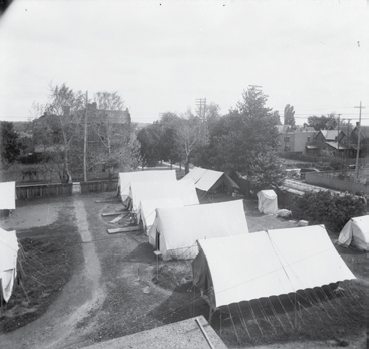
LAC-PA-042769
Robert Surtees designed the west wing of hospital and on May 16, 1873, the corner stone was laid with full Masonic rituals by the Governor General, Lord Dufferin. The new hospital had significantly more capacity (75 beds) and, according to death records from the late 1890s, there was a working morgue in the basement. The hospital continued to treat some cases of contagious diseases and during the 1912 typhoid epidemic, tents were erected on the grounds of the hospital to house the overflow of patients. When Wallis House was converted into condos in the mid-1990s, large yellow crosses painted over the brick were discovered by the construction workers. It is thought that this may have been a mark with arsenic paint for the wards reserved for typhoid patients.
Then, in 1918, came the Spanish flu. Spread largely by the return of soldiers from Europe after World War I, the Spanish Flu hit Ottawa as well as the rest of the world. All Lowertown hospitals were called on to take in patients. On October 4th, 1918, the public health authorities closed all schools, theatres and places of worship for a few weeks to try and contain its spread. Sound familiar?
The Spanishflu may have played a role in the decision by then Mayor Fisher to build a new hospital far from downtown. This led to the construction of the Ottawa Civic Hospital on Carling Avenue , in what was then a vast expanse of fields across from the Experimental Farm. In 1924, the Carleton County Protestant General Hospital was one of the institutions that closed their doors and transferred their services to the Civic.
Born out of an epidemic, and closed down in the aftermath of another, the former incarnation of Wallis House, the Carleton County Protestant General Hospital, has a rich history which continues to echo what is on everyone’s mind these days. We hope to be able to explore these links further as we prepare to celebrate the 150th anniversary of Wallis House in 2023, post-Covid-19 hopefully!