By Nancy Miller Chenier
The optimistic message in the Rolling Stones’ 1964 song “Time Is On My Side” is a good one for Lowertown. Residents and businesses keep hoping that things will get better over time. And since the founding of Bytown in 1826, time just continues to pass. So, how’s about a little look at public timekeeping methods from our early days to the present?
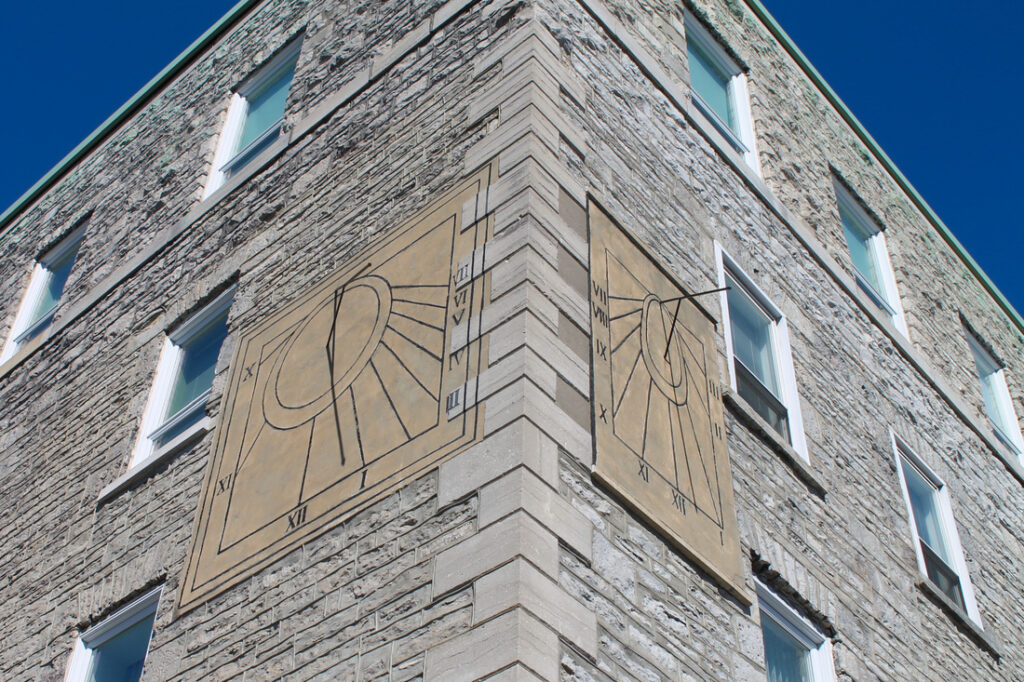
In early Bytown, public clocks were nonexistent. For individuals passing along Sussex Street, the matching pair of sundials on the second storey of the Grey Nuns Mother House provided the approximate time of day for passersby. Completed in 1850–51, these unique sundials designed by Father Jean-François Allard stand as the first timepieces visible to any resident in the developing community.
Father Allard was born in France and arrived in Bytown shortly after the arrival of Elizabeth Bruyère in 1845. He was briefly the spiritual advisor for the small group of the early Sisters of Charity. At the same time, he used his mathematical and scientific knowledge in the newly established school.
It seems that within a few decades, other publicly visible timepieces became accessible for glances by residents. When the first Parliament Building was completed in the 1870s, it had a clock in the Victoria Tower. This public clock was soon joined by the clock in the old post office and customs building that once stood on Elgin Street.
In the 1920s, David Wolfson joined several other clock and watch businesses in the ByWard Market area. In seeking an advertising advantage, he hung a clock sign outside his shop at 119 Clarence Street. When the George Street Plaza was revitalized in 2017, the Wolfson clock sign was unveiled as part of the design.
But other working clocks had already become part of the ByWard Market by then. In 1983, the Time Square building (originally called the Atrium in the Market) at 47 Clarence Street was designed as a joint venture between Glenview Corporation and Teron International. The building was topped by a tower that had an analogue clock on three sides.
Jump ahead a few years and the rejuvenated Larocque’s Department Store at the corner of Dalhousie and George streets got a clock tower in the late 1980s. Architect Barry Padolsky added a corner clock tower displaying two faces of an analogue clock. The statue of the Roman god associated with trade and commerce on top of the tower gave the building its new name—Mercury.
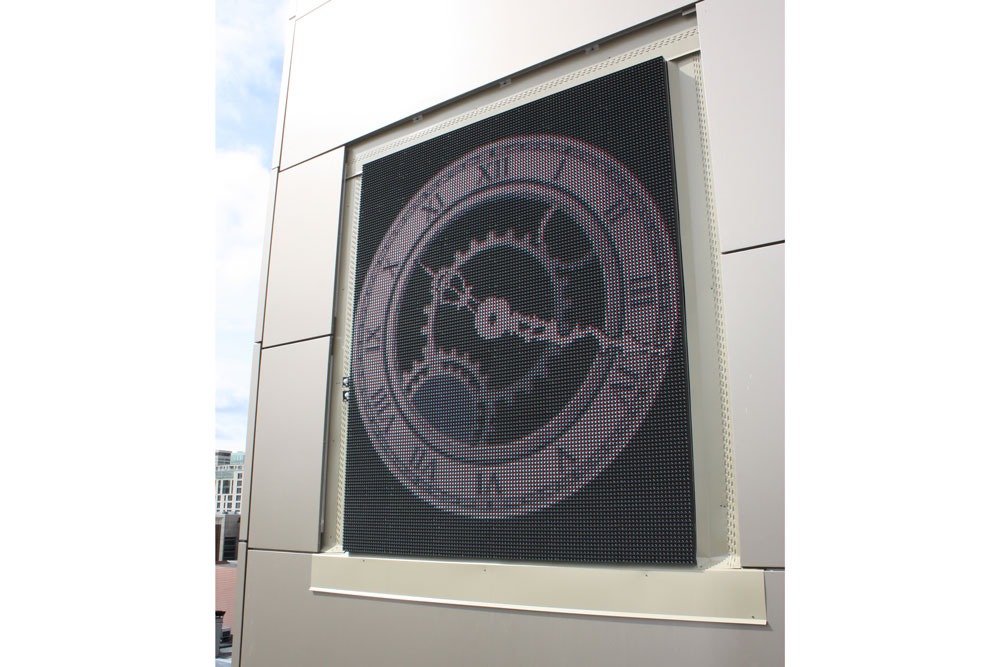
Lowertown’s public clocks moved into a new era with the introduction of a digital clock on the Time Square tower. The replacement of a traditional clock face with a three-sided, high-definition digital message centre, with a clock image and limited text, was somewhat controversial. Concerns were raised about an adverse impact on the ByWard Market Heritage Conservation District and nearby residents created by the introduction of intense illumination and movement.
But time just continues to pass, and the views associated with our public timekeeping objects are now just part of our daily landscape. At present we have multiple private ways to observe time with watches and phones and computers. But let’s hope the loss of the familiar National Research Council time signal at the beginning of the long dash doesn’t mark the end of our familiar clock towers or Lowertown’s ability to keep with the times.