
By Michel Rossignol
The Royal Alexandra Bridge quietly celebrated its 120th birthday recently. A locomotive made the first crossing of the bridge on December 12, 1900, shortly after the end of construction. Initially called the Interprovincial, in September 1901 the bridge was renamed the Royal Alexandra Bridge in honour of Queen Alexandra, the wife of the new British monarch, King Edward VII. When he died in 1910, King Street was renamed King Edward Avenue, so the royal couple left their mark on Lowertown.
At first, the bridge was used only by Hull streetcars and regional trains travelling in Eastern Ontario and Western Quebec. However, by the 1930s, it became an important part of the Canadian Pacific rail network which, like the Canadian National network, linked together communities across Canada.
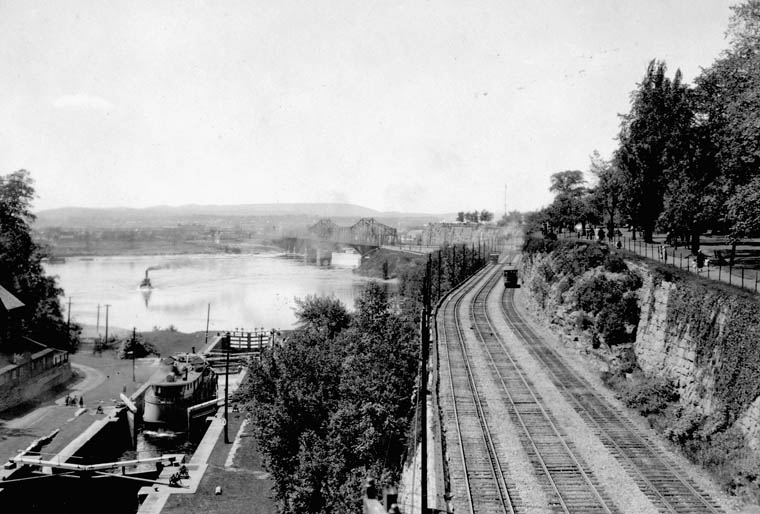
The Canadian Pacific, which owned the Royal Alexandra until 1970, used it so that its trains to and from western Canada could arrive and leave Ottawa’s Union Station through the northern entrances. After crossing the Royal Alexandra, trains going to Vancouver travelled a short distance through Hull before returning to Ottawa by crossing the Prince of Wales Bridge near the Chaudière Falls to continue westward. Trains arriving from the west used the same route in the other direction, giving passengers a beautiful view of Parliament Hill and the Rideau Canal just before they entered the station.
In the 1950s, Canadian Pacific bought new locomotives and railway cars to provide faster and more comfortable cross-country travel. Starting on April 24, 1955, a train called The Canadian with new silver coaches, dining cars, and sleeping cars (still used by VIA Rail today) travelled daily between Montreal and Vancouver, with a stop in Ottawa.
At the invitation of Canadian Pacific, A.Y. Jackson and other Canadian artists had painted murals for the new railway cars. Thus, between 1955 and 1966, trains carrying Canadian art and many Canadians crossed the Royal Alexandra daily near the present site of the National Gallery of Canada.
The Canadian and other trains stopped crossing the Royal Alexandra in 1966 when the new train station on Tremblay Road was completed. Railroad operations were moved away from the Union Station area as recommended by the Gréber Report of 1950 which guided Ottawa’s development. At about the same time, the railroad yard north of Boteler Street was replaced by the road leading to the Macdonald Cartier Bridge. Thus, Lowertown was no longer connected to the rail networks across Canada.
Since 1966, only pedestrians, bicyclists, and vehicles cross the Royal Alexandra, but the bridge is still an important, historic intercity and interprovincial link.