
By Nancy Miller Chenier
The distinctive features of the houses that remain across from the Shepherds of Good Hope shelter are hidden under drab grey paint and behind protective black metal fences. The unified streetscape has already lost the distinctive two-storey house at 207-209 Murray with the creative brickwork pattern on its facade.
And for some reason, 215 Murray has never been recorded in any city directory or fire insurance plan. The surviving buildings, several originating as early as the 1860s, were included in the Lowertown West Heritage Conservation District in 1992.
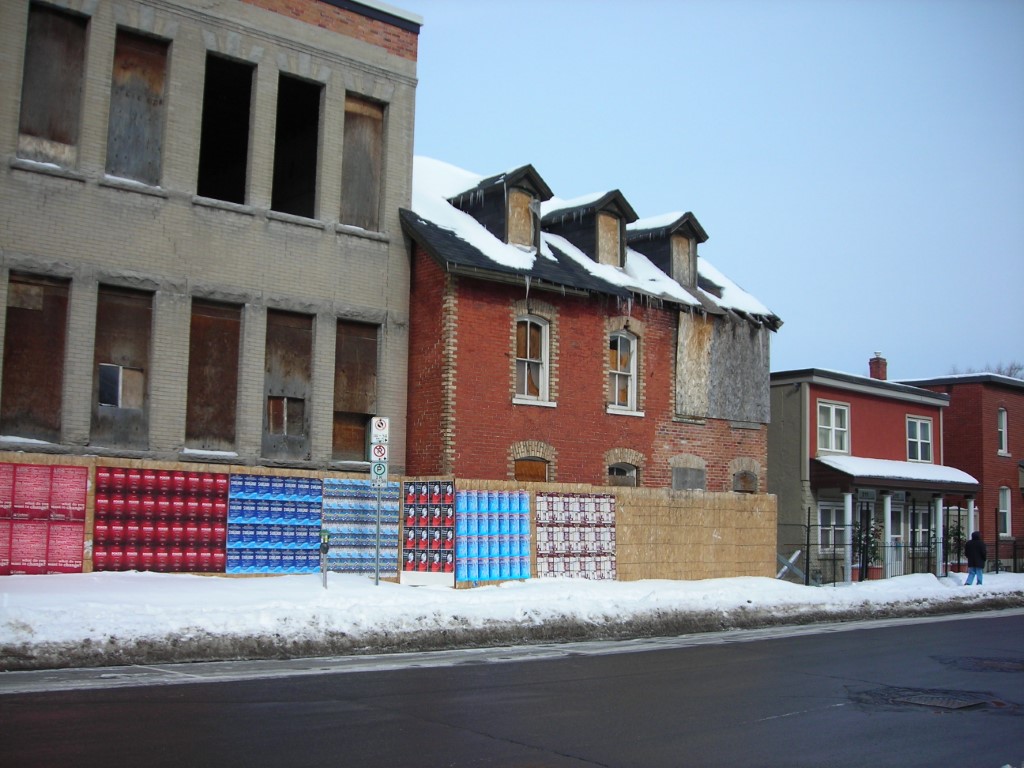
Today, with many of their heritage architectural features concealed, the houses between Cumberland and King Edward reveal few of the characteristics that once made them vibrant family homes over the last 150 years. Like so many Lowertown buildings, each house still standing has a story, in this case a story of diverse families with different origins and backgrounds.
When this section of Murray Street was developed, it was a typical Lowertown street with wooden homes lining both sides. By the 1880s, it had a school at both ends: Notre Dame, now the site of the ruins of Our Lady’s School facing Cumberland and an earlier building for St Bridget’s School (the present-day site of the Shepherds of Good Hope shelter) facing King Edward Street.
By the 1890s, English-speaking Catholics had the choice of the newly built St Brigid’s Roman Catholic Church for residents who did not want to walk to Notre Dame on Sussex.
The houses eventually acquired brick facades. After the turn of the century residents of the growing Jewish community had the choice of several nearby synagogues, first Adath Jeshurun on King Edward followed by Agudath Achim on Rideau Street and eventually Machzikei Hadas on Murray.
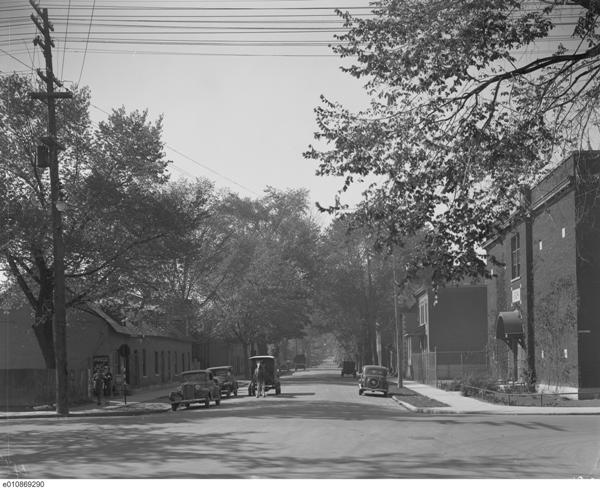
Horse-drawn vehicles travelled in the area, some of them driven by Stanislas Hotte, a cabman born in Quebec who lived on Murray Street and was the original occupant at 211-213. In the 1863 city directory, he is listed on the street, presumably with his wife Philomene Jolibois, whom he had married several years earlier. His cab work occasionally resulted in a news story when he was perceived to be in contravention of a city bylaw for parking in the wrong place or being in an accident with another vehicle.
Elizabeth Birdwhistle at 217 Murray outlived two Irish-born husbands. The first, a Murphy, left her with two children and possibly the frame house where she was living at the time of the 1861 census. By the 1881 census, she had married Thomas Tallon and added five more children to the household.
After Thomas’s death, she worked as a fruit dealer on Rideau Street and later may have relied on income from her daughters still living at home, one who was working as a salesclerk and the other as a seamstress. Her oldest son, Edward Murphy, was living in the house in 1923.
By the 1930s, the Italian family of Charles and Theresa Crivellaro were occupants at 217 Murray. During the Second World War, when housing was scarce, they divided the house and shared with the Panasiuks, a Ukrainian family. Over the years, the Crivellaro children were active participants in the community, serving on the local Bingham Square Youth Village as well as with several Italian organizations.
At 223 Murray, Norbert Sevigny was an early occupant, possibly from 1863. His son, Norbert Joseph Sevigny, a onetime blacksmith at the ByWard Market, eventually lived in the house for a few years with his wife Catherine Boese and some of their ten children. Many of the family stayed in Lowertown, with several sons in business as barbers while some daughters worked as tailors and hat makers.
The Steinman family, who had emigrated from Russia, were longtime owners of 227 Murray Street, with the house passing over the years from Hyman and Mollie to daughter Leah. In 1923, Hyman was listed as a pedlar. Max and Minnie Drazin, owners of a fruit business at the ByWard Market, were at 229 Murray. Max was president of the synagogue at Murray and King Edward, and by 1933, he and Minnie were recognized as prominent members of the Jewish community.
The occupants and the buildings changed over the decades but the homes endured, some headed by men, others by women.Most were Roman Catholic and some were Jewish, a mixture of those with origins in Quebec, Ireland, Russia, Italy, Ukraine, and other parts of the world. Like the rest of the community, employment opportunities developed that allowed a movement from blue-collar labourers to white-collar work as business owners and retail clerks.
All the elements that help make a community vibrant were here. It was part of a true 15-minute neighbourhood, with places to shop and play and have religious observances; schools to educate children; respectful but not necessarily similar neighbours; and most of all homes. The challenge for our city and our community going forward is to conserve and reimagine this Murray Street block as homes for a new Murray Street mosaic.