
By Warren Waters
Will Lowertown accommodate a growing population? And if so, where and how?
The City of Ottawa’s revised draft New Official Plan (whose revised sections are now being posted at https://engage.ottawa.ca/the-new-official-plan) is, like all urban plans, not simply about the documents — it’s about how we handle (or not) controversial urban problems.
All plans leave their mark. Urban planning in Ottawa started in the 1820s with Colonel By’s layout, which separated the “lower” town from the upper classes by neighbourhood, keeping land ownership in safe, well-to-do hands. One plan after another has followed, each searching for solutions to urban ills, including our infamous 1960s urban renewal, whose scars are still visible in our community.
And let’s not forget intensification, always fuel for argument, with tall buildings surrounding low-rise communities.
So what about Lowertown in the current draft plan? Almost everything here is labelled as “evolving” (except for a small area to the east of Nelson or Rose Street and north of York), with references to“a gradual evolution over time that will see a change in character to support intensification…” [OP 5.6.1] The plan also counts on real estate increasing in value — land transactions and land value fuel our city’s budget.
Population growth is expected to drive economic growth, with a larger working population paying for public services. In what is called our “downtown transect,” the target residential density range along minor corridors and within neighbourhoods is 80 to 120 dwellings per hectare. Along major corridors, in hubs and near major transit stations, the minimum residential density target is 350 dwellings per hectare. There’s nothing about paying budget expenses if growth slows.
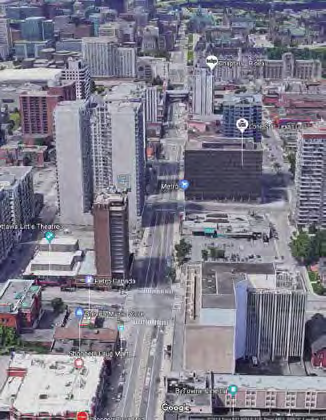
Plan critics fear canyons of high-rises along major corridors, with towers looming over people’s backyards. Supporters point out that people have a right to live somewhere, so why not where services are cheaper to deliver?
Controversially, the draft permits emergency and transitional shelters in all urban designations and zones, which may actually help Lowertown by allowing every Ottawa neighbourhood to shelter those unhoused.
But shelters are not real housing. As for the latter, the plan does aim for 10 to 15% of new residential units to be affordable, with 65% of them to be “deeply affordable” and the remaining 35% “market-affordable.”
The revised draft commits to (someday) undertaking a secondary planning study for the Byward Market Special District, but much of its current wording is still based on a repackaged Public Realm Plan, which ignores private spaces and the residents who live there and promotes entertainment over groceries and other land uses.
I have yet to find any protection for a new crossing to Quebec, to take the truck traffic off King Edward Avenue — but you may be luckier than I was.
Most newsworthy topics are covered, not just those mentioned above, so look up your concerns and get informed. All plans try to reconcile divergent interests or views, and most compromise to maintain peace. But the future really is unpredictable!